A Level Art and Design: Three-Dimensional Design
Students will study this as an A Level course, although in certain cases an AS Level may be a more appropriate route.
We follow the AQA Art and Design specification. This course follows the Three-Dimensional Design pathway, focusing on designing and making objects, structures and spaces.
Click here to see the AQA specification.
A Level Three-Dimensional Design
Component 1: Personal Investigation
- No time limit
- 96 marks
- 60% of total A Level marks
Students will develop their skills and understanding of three-dimensional design by exploring different materials, processes and techniques. They will research artists, designers and craftspeople, experiment with ideas and produce practical and written work leading to a final outcome.
Areas of study
Students are required to work in one or more of the following areas:
- Ceramics
- Sculpture
- Exhibition design
- Design for theatre, television and film
- Interior design
- Product design
- Environmental and architectural design
- Jewellery and body ornament
- 3D digital design
Component 1: Personal Investigation
This is a practical investigation supported by written material.
Students will choose their own idea, issue, concept or theme and develop it into a finished outcome or a series of related outcomes.
They will:
- Research artists, designers and craftspeople.
- Explore different materials, processes and techniques.
- Experiment with ideas and develop their designs.
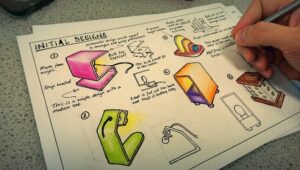
- Record their progress through drawings, models, samples and sketchbooks.
- Explain their creative decisions and evaluate their work.
- Develop a final outcome that reflects their research and ideas.
The investigation should show clear development from the initial idea through to the final outcome, demonstrating independent thinking and problem-solving.
Written investigation
Students must produce 1,000–3,000 words of written work to support their practical investigation.
The written work must:
- Explain the focus of the investigation.
- Discuss relevant artists, designers and contextual research.
- Explain decisions made during the design process.
- Reflect on practical work and the development of ideas.
- Use appropriate specialist vocabulary.
- Include a bibliography of sources.
- Be clearly written, with accurate spelling and punctuation.
The written and practical work are assessed together against all four assessment objectives. Students must acknowledge any sources or work that are not their own.
Component 2: Externally Set Assignment
Students will receive an exam paper from AQA containing eight starting points. They must select one and develop their own response.
Preparatory period — from 1 February
Following receipt of the paper, students should choose a starting point and develop their ideas through research and experimentation.
Preparatory work may include:
- Sketchbooks and design sheets.
- Drawings and annotations.
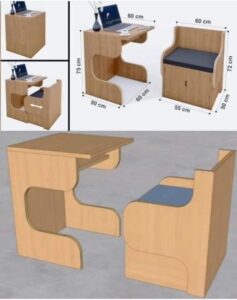
- Models and maquettes.
- Material and process experiments.
- Research into artists, designers and craftspeople.
- Plans for a final outcome.
Supervised time — 15 hours
Following the preparatory period, students must complete 15 hours of supervised, unaided work to produce a finished outcome or a series of related outcomes.
The first three hours must be consecutive.
Students may refer to their preparatory work during the supervised sessions but must not add to or amend it. All work must be kept secure between sessions. Internet access is not permitted during supervised time, apart from permitted web-based applications.
The preparatory work and final outcome are assessed together against all four assessment objectives. Students must demonstrate independent working, creative development and the ability to complete their work within the time limit.
Skills and techniques
Students will develop skills in:
- Exploring form, shape, texture, colour, decoration and surface treatment.
- Understanding scale, proportion, structure, rhythm and movement.
- Using a range of appropriate tools and equipment safely.
- Model-making, construction and assembly.
- Experimenting with materials, processes and technologies.
- Understanding the relationship between form and function.
- Designing for a particular audience, purpose or setting.
- Developing ideas in response to a brief, theme or design problem.
Knowledge and understanding
Students will learn about:
- Different materials, processes, technologies and resources.
- How ideas, feelings and meanings can be communicated through objects and designs.
- Historical and contemporary developments in three-dimensional design.
- Different styles, genres and traditions.
- How design relates to social, cultural, environmental and ethical issues.
- The relationship between an object or structure, its purpose and its surroundings.
- Specialist vocabulary and terminology relevant to their chosen area of study.
Students should explore both traditional and contemporary approaches to three-dimensional design, using research, drawing and practical experimentation to develop their own creative ideas. They will learn the importance of the design process as well as the final outcome.